Due to the recent light of emails regarding our IASTM CLINIC on the website of Chakshu being the rightful owner of Physioneeds Academy (India), we do not have any association nor affiliation nor partnered. Our logo for IASTM CLINIC and the course modules on the website bears no official association from us and had been copied and pasted. Kindly check with us for more clarifications on workshop offered on their website.
-
Dry Needling practice
With the current demand we are all seeing a huge spike of healthcare providers and allied health therapists seeking Dry Needling as an added modality, but what actually is DN and who can practise it? Let's start by where it came from and give you the timeline of DN so that we have a rough idea of what's what by the end of the read.The needles that are used during dry needling sessions are called filiform needles. Today, the most commonly used needle is made from stainless steel. Very occasionally, silver or gold needles are used. They come in different sizes and the needles are flexible and very thin. The length can range from 1cm to l5cm. Diameter (thickness) can range from 0.25 mm to O.46 mm. They are the exact same needles that are used by Licensed Acupuncturists. Filiform needles are almost hairline in terms or the thickness (figure 1a). They are non medicated and are not hollow (like a sewing needle). The needles are a one- time use and are doweled. Comparison of the diameterThe handle of different filiform needles are as well something to consider, as we all would know this by now that we will need variety or choices to suit our individual style, feel and personal preference. Only after using the different types of handles will you have your own preference!
 Different DN handlesDry needling historically started with Dr Janett Travell and David Simons in the early 1940’s when it was first proposed. Physicians injected various substances which included corticosteroids, analgesics, saline, etc. into trigger points. Which is now considered "wet" needling to compare to dry needling as there was a form of liquid inserted into the area of trigger point. The latter which is termed "dry" needling is due to the type of needle which is widely used during dry needling by therapists (Figure 1.1)
 Fig 1. Hollow needles used for injection of trigger point(s)
 Fig 1.1. Filiform needle used in dry needlingDry needling courses or workshops are currently only offered to Licensed Healthcare Providers which may include Physiotherapists, MDs, Chiropractors, Occupational Therapists and others that has done a full time graduate degree in health sciences as this is considered an invasive modality and there is a chance of puncturing the organs (pneumothorax case) under the supervision of a poorly trained person who isn't trained enough in the anatomy region. The courses are usually offered anywhere from 2-7 days depending on the organisation and breakdown of the curriculum, whereas a licensed acupuncturist has a minimum of three years of supervised training. So the next course you hop down to, make sure you know how long the facilitator(s) has had in training hours, practical experience hours of application and so on.The difference between acupuncture and dry needling lies within the approach of treatment.Acupuncture:
- Uses meridians points as the blue print map
- Treats illnesses and diseases
- May use moxibustion (Fig 2.)
- May advise on natural herbs to help stimulate the body's healing process
Dry Needling:
- Targets the connective tissues (musculoskeletal)
- Targeted towards inducing micro trauma to start the healing process
- May use kinetic chain based thought
- May advise on exercise and rehabilitation to help re- modelling of the tissues
 Fig 2. Acupuncture moxibustionThere is a big debate now as to these weekend courses allowing practitioners to practice the next day after attending a DN workshop. These are two separate systems which for now are strikingly similar to the laymen, but both practitioners are approaching a treatment with totally separate training backgrounds and targeted systems (so to speak). Licensed acupuncturists around the world are against this idea of having trained during a weekend course and then practicing the next day on patients with little training. Most insurance companies do not cover dry needling as well as it is not yet seen as a regulated procedure. While there isn't a regulatory body in Singapore to say that DN is only reserved for certain healthcare professionals who are not LA (licensed acupuncturists), it is still within the scope of conduct of each healthcare provider to research viciously whether adding this modality is safe to practice and have enough training to not cause patients more harm than what they came for. As this is still a new and upcoming approach of treatment, we are sure that in the future, more regulations will be added to add more benefits to patients with chronic and maybe even acute phases of pain / injury.
-
Due to a recent infringement of Intellectual Property from our IASTM CLINIC agreement with Physical Therapist Kanu Kaushik (India), owner of Kinesio Prehab Institute, we are no longer in association with him in recent light of copying and delivering our courses throughout India and Malaysia without our permission or knowledge under the name (KIASTM). To the participants whom has taken our IASTM CLINIC with him personally, kindly take note that the certificates are not valid and are just modified copies. Kindly contact us should you need more clarification and leave us an email at general@itigrad.com.
-
The connective tissue that connects every..
Every day we get some light sine on the topic of fascia. It's currently the most anticipated topic which is still newly researched and it's going somewhere thats for sure. Might we even say, there is a new way to now view the body not only in a skeletal way, muscular way but a holistic approach to how it(fascia) connects the dots to our very pains and where it started from.For manual therapists, who is usually trained to work on the site of pain, now it is being approached in the fascia continuum theory! Personal trainers, Yoga Teachers and so many others are having a go at the current theory which has worked well than the older approach of treating the site of pain and so on. They cover how Acupuncture, Exercise and Manual Therapy affects our fascia.
The video uploaded has a limited time for viewers to view this current short documentary, so hurry and click below to see what Tom Myers, Robert Schliep and other frontier reseachers on fascia are saying and how it will lead the way.
A MUST WATCH!
-
Pain
Many of us have pain and try to get it treated somehow or rather. We seek Physiotherapists and then they get you to move in a specific detailed manner, gives you home work to do and you go off doing it for a week or so then recover and you decide not to do it anymore. Some of you find a personal trainer to get back into shape as there is pain caused from the lower back due to the weight that you are carrying from being overweight and sedentary. Some might even go to the Chiropractors to get treatment which is going to help them rid of pain by adjusting you into alignment, go for a few session, get better and then go missing, only to come back again after few months for the same pain that you felt when you first sought out these experts to treat your pain. While some of us may take a DIY approach to our management of pain, we all have pain and we deal with it differently let alone react to the treatment. Sounds awfully familiar doesn't it. Nothing is wrong with any of the choices you make however what you do after may be putting yourself in high risk of re-injuring yourself. I pray that you will stay with me after this sentence, you healed poorly. I know, i used the word, healed(past tense), but the process of healing take one missing link, just a small one, ok maybe two. Still with me i see, good. I will give an example here.Case study example
Its the weekend off from the office! You’re playing soccer and you fall down forward and to break the fall you put your hands out and land on your wrist. Sure you get up and play again and nothing happens after 30-40 minutes after the game stops. Its feels sore but eventually you just shrug it off and let it recover like the good old times. The fews week later you start having pain in your shoulders, you see the GP and eventually he gives you anti-inflammatory medication and said to come back if it doesn’t heal. Sure enough it healed and the quality of life returned to normal. You start kiting weights regularly and then few months later, you have a shoulder pain! AGAIN! Your quality of life plummeted downhill as you can’t even lift your arms to put on a tee shirt. This is the best part yet, you think the gym sessions might have contributed to the shoulder pain and you see a Physiotherapist, Chiropractor, Osteopath or whoever and they all take the case the same way. They mobilize and massage your shoulder, asks of you to do some exercises and see them few times a week. Three weeks passes by with combined effort from therapist and yourself. You're waaay better, quality of life seems to be right on track, not exactly the best in range of motion but at least without pain. You go to the gym and try to stretch it out and get some rehab work done after doing some heavy research on google about stretching and increasing range of motion for shoulders. You seem to be on track and somehow in the week to start feeling a tingling sensation in your shoulder blades. That tingling or small pulses of localised sensation is what we call a trigger point.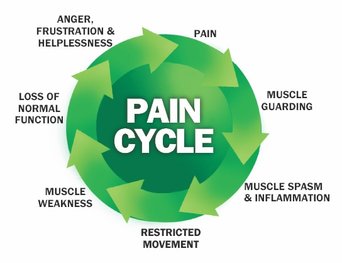
-
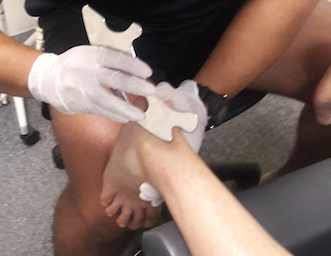 Achilles Tendinopathy
There's a new buzzword going around the manual therapist's newsfeed around the world now. IASTM, also know as Instrument Assisted Soft Tissue Manipulation/ Mobilzation. This additional modality is picking speed like wild fire across the globe for its efficacy and the plethora of clinical cases that practitioners can apply it into. Iastm is a very safe, non invasive, portable and the duration of soft tissue works last no more than 90secs on areas that needs to be treated. Let’s dwelve deeper into why practitioners everywhere are picking this up!
What is this therapy tool?
The IASTM tools that are used widely by practitioners nowadays are mostly made up of Surgical Steel. The therapist will then use this tool to glide across the skin to feel for any peculiar feel of the soft tissues, this leads the therapist to proceed and see what might be the underlying soft tissue that may have a big impact on the current patient. This particular gliding on the skin using the tools helps to feel far deeper and more constant by giving the therapist feedback from vibrations that is given back via resonation of the tools upon gliding across the tissues. One can as well use the tool for both Diagnosis and Prognosis purposes, which again is a very quick and simple indicative of looking at how fast the body is flushing waste product out of the affected area. Through Myofascial Induction, the practitioner uses a specific technique to induce change in the connective tissue. The best part is, only two people can feel if there is any restrictions or soft tissue build up, the therapist and the patient. Who can use this tools?
It's mostly preferred by providers that offer treatments to musculoskeletal dysfunctions as IASTM is usually complimented or accompanied with other types therapy which may include corrective exercises, joint mobilizations or just about whatever your current practice background is. Though anyone with a keen interest can still pick it up to learn self management.
Why so many different tool?
Most IASTM tools are made with a vast difference of shapes and sizes due to ergonomics for the practitioner's handling, contours to fit different parts of the body, angles to help exert more force for deeper soft tissue work and of course the patients comfort. There isn't a one tool fits all unfortunately as there will be parts of another tool which will help you work more efficiently around certain body part area.Why should I use the tools, not my hands?
If you already are doing manual therapy then you would know that sometimes you can't go deep enough, tired hands, fatigued fingers and can spend quite a bit of time with patients applying techniques that applies the same concept with IASTM just a lot more shorter with time. Using the tools will help in terms of providing the therapist better leverage to apply deeper force, save hands from fatigue and get better feedback from the soft tissue. While IASTM is NOT supposed to replace your hands, it helps practitioners feel more and get deeper feedback from resonation via the tools, allowing your hands to do what they do best. The resonation from the tools are somewhat how bats uses echolocation to locate food/ navigate their way around, we use the the tool to navigate and feel for soft tissue irregularities etc.
How to start
You can start with a very simple technique called scanning. Here you will be able to feel some tissue irregularities both superficial and deep tissues. This is done at the very beginning of most IASTM induced work thereafter you apply specific trchinqies based in your desired outcome or goals. -
IASTM
IASTM(Instrument Assisted Soft Tissue Mobilization) is a great way to "straighten things out". If you have pain along your IT band then you can do a few easy routine to help you release some tension along the chain. This will be about the same as the foam roller or the gym stick, both the foam roller and the stick do not shift or drag the tissues(myofascial release) and cause a change. Using IASTM, you can either use it to increase blood flow and disperse by products that may be causing scar tissue build up or create micro tears to recreate a better tissue profiling. The tools are great for recovery, increasing your strength, increasing mobility and movement re-education. Most of the tools are used by qualified healthcare providers as some of the application by the tools can cause severe bruising. I would think anyone could do this as they are known as Gua Sha but when you do it make sure you stop before even coming close to bruising and right after redness comes about. That localized heat will allow your soft tissue to increase more blood flow to the affected area and bring in nutrients helping recovery and your performance.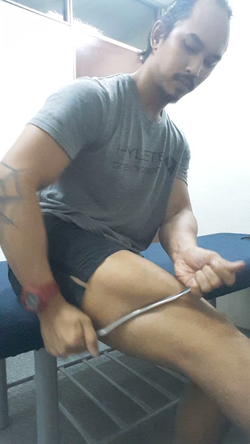 It can be quite a discomfort so go slowly!!Foam Rolling
Foam rolling has gotten the boot for not being a true myofascial release technique but rather, more on analgesic therapeutic effects. Nevertheless, foam rolling has been know to help countless people from all walks of life, level of physical activity and nagging pains. Use the foam roller before your run, after and when you are resting and not running as it doesn't take much out of your breath as to running. You can buy them off most online store and use them whenever you like with an abundance of videos to follow on instructions, but as usual having someone who is well versed in them is as well advised as they can teach you what NOT to do and what to do to better optimise your time actually doing what you are supposed to do and how to do it. It's easy to do and convenient to carry almost everywhere as well. If you are to pick up a foam roller and do your thing, just bear these three things in mind.
1. Do it slow, very, very slow..
2. Look for a tender spot and work on it till the pain decreases or goes away.
3. If you feel very tired or that you are challenging your metabolic rate foam rolling, you're doing it wrong! Go find someone who has sat through proper instructions to use them!
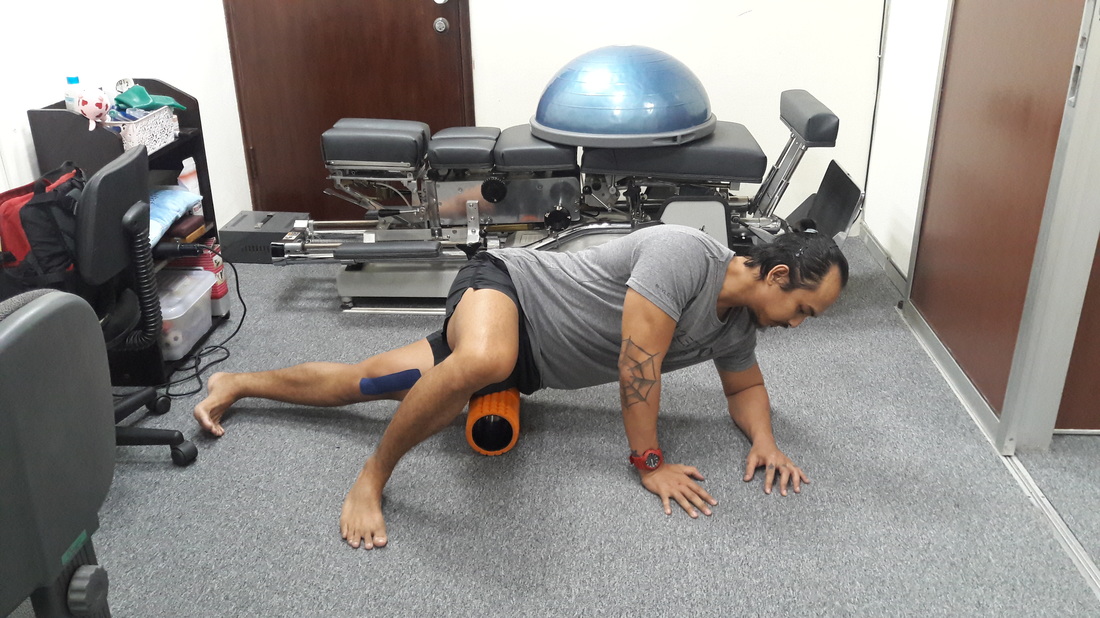 No space, no problem..
Soft Tissue work
Restorative type of tissue work helps tremendously when you have pain during and after your run especially your IT band, which may be referred down to your surrounding areas of the knee(mostly on the outside of kneecap due to tightness of the IT band). Soft tissue therapy helps to increase blood flow which in turn can help recovery and improve performance. It as well helps with restoring length of the tissues if your therapist incorporates deep tissue work and pin and stretch. Pin and stretch is one of the great way to release "junk" in an area where the fascia is not moving or just have been getting quite a lot of trauma from running. Key areas where you want to get it worked on more would be your glute medius, IT band, and your bottom of your feet, the rest is secondary which is your hamstrings, thighs and shins. Aaaaalways make sure your therapist is qualified, to give you proper treatment!
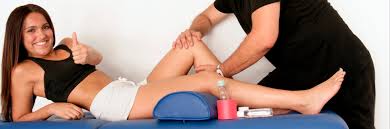 Massage therapy. Thumbs up. period.Yoga
Yoga is both mind and soul for most. It helps the mind relax all the nervous system and allowing the body to follow through. Ever heard of the mantra, meditate your problems away? It's for a good reason. Might not be your usual go to but yoga has been known to decrease blood pressure and if you're always physically stressing your body, its time to take some time to let it heal through yoga. Alongside the side effects of doing yoga is that it help with balance(great for running) and helps you stretch out areas that you hardly will do before, and after running. Easy, cost effective and highly beneficial. Picture paints a thousand wordsKinesiology Tape
The tapes have been brought to attention to our eyes for the colourful and designs on the tapes. While some use it to look stylish they have been known to help decrease pain and improve performance immediately through neurophysiological feedback.The tapes are amongst the cheapest alternative, very portable and fuss free to apply. To apply the tapes effectively, you will need some basic understanding on how much tension you want to use, which direction or shapes you want to use, other than that just applying the tapes will help in a general situation where you have aches and pains from running. The tapes also helps with increasing blood flow through the lifting of the skin and it does not restrict movement, instead, it helps promote healing through movement whilst having the tapes on you. Though, there are general techniques that you can use to help with posture, decreasing of pain, improve performance, there will be times when you need someone qualified to help you type if you feel that after taping there is just a small magical changes in what you are trying to achieve.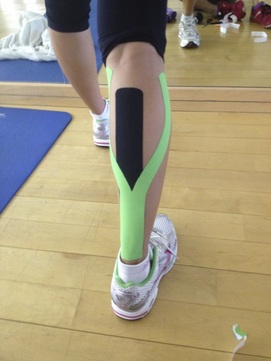 Kinesiology Taping for Calves
More importantly is that you learn how to give your body the rest it needs, even the computers needs to be switched off! - Jab